|
Mayapple (Podophyllum peltatum): Source of epipodophyllotoxin used to make
etoposide, which is used against small-cell lung and testicular cancer as
well as lymphomas and leukemia. Also a source of teniposide, which is
used to fight cancers such as brain tumors in adults and neuroblastoma in
children. |
|
Sneezeweed (Helenium
autumnale): Several chemical components of the genus have interested
serious researchers. The chemical helenalin for example is a potent
anti-inflammatory pain relief medication, anti-tumor agent, & even has a
potential for treatment of leukemia [Kasai et al, Journal of Natural
Products, 1982]. Unfortunately helenalin has serious toxic side effects
that make its use both as an herbal remedy or a pharmaceutical grade
extract dangerous especially to the hepatic system. Another isolated
chemical, microlenin, has been shown to inhibit cancer growths, & was
not as apt to cause cellular damage as was helenalin [Hall et al, The
Journal of Pharmacological Science, 1983]. |
|
Cone shells are
marine snails and are found in reef environments throughout the world.
They prey upon other marine organisms, immobilizing them with unique
venoms. Upon investigation it was found that the toxins in cone shell
venoms possess pharmacological qualities that make them valuable tools
in medical research and have great potential for relieving pain.
One such product is
Ziconontide marketed as Prialt®. |
|
True Indigo
(Indigofera tinctoria): The leaflets and branches of the indigo plant
yield an exquisite blue dye; people around the globe have used it to
color textiles and clothing for centuries. In the traditional medicine
of India and China, indigo was used in the treatment of conditions we
would now call epilepsy, bronchitis, liver disease, and psychiatric
illness. Based on its traditional use for liver problems, researchers
have investigated whether indigo might protect the liver against
chemically induced injury. Animal studies do suggest that extracts of
the indigo species Indigofera tinctoria protect the liver from
damage by toxic chemicals.
A chemical compound isolated from indigo, indirubin, is being
used in China for treatment of chronic myelogenous leukemia, and various
synthetic derivatives are in preclinical studies in Europe and the US. |
|
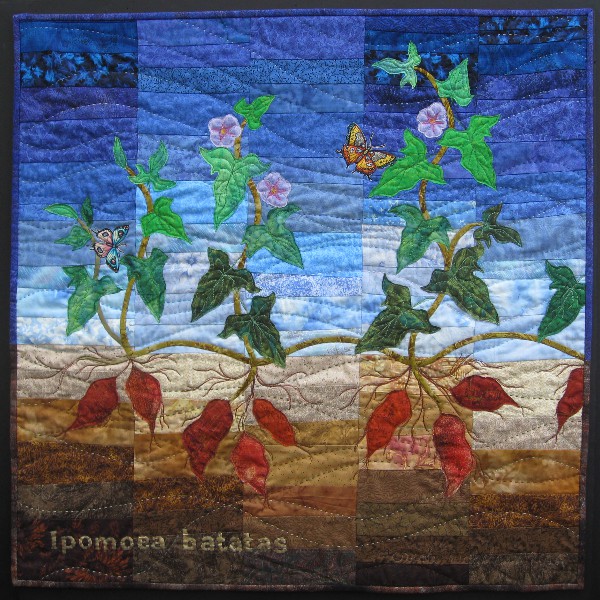
Sweet Potato (Ipomoea
batatas):
A potential anticancer agent, ipomeanol is produced only if infected
with fungus. Antioxidants play a role in the prevention of heart
disease and cancer, and sweet potatoes supply plenty of the
antioxidants, vitamin E and beta-carotene. These substances are
effective in neutralizing free radicals, which are responsible for
damage to cell walls and cell structures. |
(Catharanthus roseus)
was once native only
to the tropical forests of Madagascar, the world's fourth largest
island, found off the east coast of Africa, but is now ubiquitous as a
beautiful ornamental plant commonly known as Vinca. Rosy periwinkle is a
source of vincristine for use against childhood leukemia and vinblastine
for use against Hodgkin's disease. It's also used against bladder and
testicular cancer. |
Feverfew/Mutterkraut (Tanacetum
parthenium) is a member of the Chrysanthemum family, sometimes called
bachelor's buttons. Now scientists at the University of Rochester
Medical Center have found that an extract of feverfew is effective
against a type of human leukemia. Researchers report that feverfew
extracts kill malignant stem cells like no other single therapy they
have tested. The active ingredient is derived from parthenolide, one of
a class of sesquiterpene lactones found in the plant. Researchers
report that animal studies suggest that a more soluble synthetic version
is safer and human trials might begin in a year.
|
Garlic (Allium sativum): A host of
studies provide evidence that garlic and its organic allyl sulfur
components are effective inhibitors of the cancer process. The evidence
is particularly strong for a link between garlic and prevention of
prostate and stomach cancers. |
Purple
Meadow Rue (Thalictrum dasycarpum) occurs in eastern British Columbia through Alberta
and Saskatchewan to Ontario, south through the Missouri River Valley to
Louisiana and Texas, and in the Rockies to New Mexico and Arizona. It is
quite common on moist to wet prairies, meadows and along creekbanks. It
can reach 6 feet tall; with purple-tinged stems branching towards the
top into large clumps of soft, almost feathery flowers. The flower heads
can be a foot or more long and have no true petals. Male flowers are
more fluffy and delicate with long, very obvious stamens. Male and
female flowers are generally on separate plants, but occasionally appear
on a single plant. Flowers are white with a green tint.
This species is currently being researched because of the presence
of the chemical thalicarpine. It has been used successfully with rats in
controlling cancer; the research continues with humans. The seeds are
the best source of thalicarpine. Research is ongoing in Heidelburg,
Germany, on its effects on ovarian cancer cells. Other research shows
that thaliblastine, an efflux-blocking drug, might have great potential
for pre-clinical development for overcoming multidrug resistance in
human malignancies, including leukemia. |
Heliotrope (Heliotropium indicum): Indicine N-oxide derived from Heliotropium indicum, a widely used indigenous drug in Ayurvedic
medicine, has been found to have an antitumor activity and a chemical
constituent, indicine N-oxide, has been used in clinical trials as a
chemotherapeutic agent for leukemia and solid tumors. |
Western Yew(Taxus brevifolia):
Source of anti-cancer compound for Taxol, which is used against ovarian
cancer, breast cancer and other cancers. |
|
The
Phyllanthusgenus contains over 600 species of shrubs, trees, and annual or biennial
herbs distributed throughout the tropical and subtropical regions in
central and southern India, China, the Philippines, Cuba, Nigeria, and
Guam. Long used in folk medicine to cure a multitude of urinary
problems, all parts of the plant are used medicinally.Since its identification, the hepatitis B
virus (HBV) has been found to be associated with cirrhosis, chronic
liver disease and primary liver cancer as well as acute serum hepatitis.
More than 200 million people worldwide are estimated to be carriers. A
series of studies has shown that persistent HBV infection is associated
with a greatly elevated risk of developing liver cancer. The Cochrane
Hepato-Biliary Research Group in Copenhagen has stated that treatment
with Phyllanthus herb had a positive effect on clearance of serum HBsAg"
comparable to interferon and was better than nonspecific treatment or
other herbal medicines for HBV and liver enzyme normalization.
|
Castor Bean
(Ricinus
communis):
The castor bean plant is a source of ricin. Ricin, linked to carrier
molecules such as monoclonal antibodies, is now being widely tested in
several therapeutic fields. Its property as a protein synthesis
inhibitor is the theory behind its trials in cancer therapy. Ricin is
used against metastatic melanoma, metastatic colon cancer, and other
cancers. |
Bouvardin (Bouvardia ternifolia): Bouvardin is the anti-tumor active agent from Bouvardia ternifolia
(Rubiaceae) of the Chihuahua Desert region of Mexico. Bouvardin was
dropped from clinical trials in the 1980's. |
Happy Tree or Tree
of Joy
(Camptotheca acuminata):
A handsome tree from China that is easily grown from seed and can be
kept pruned to desired size indoors with ample warmth and bright light.
Chemically active parts include new leaves and seeds, as well as wood,
bark, stems, and roots. The cancer medications topotecan (for ovarian
and lung cancers); irinotecan (against metastatic colorectal cancer);
and 9-aminocamptotecin (undergoing clinical trials) are semisynthetic
derivatives of camptothecin, which appears to stunt tumor growth. |
Poison Dart Frog (Epipedobates
species) is a source of potential non-addictive pain killer. The tiny
poison-arrow frog is a native of Ecuador. It secretes epibatidine, a
chlorine containing substance with a chemical structure unique to
science. Epibatidine is reported to be 500 times more potent than
morphine, which is leading the pharmaceutical industry to explore
synthetic analogues as novel analgesics. |
Dyer's Woad (Isatis tinctoria): An ingredient, indirubin, is reported to have anti-neoplastic
activity and is widely used in China in the treatment of leukemia.A chemical compound
isolated from Indigo, indirubin, is being used in China for treatment of
chronic myelogenous leukemia, and various synthetic derivatives are in
preclinical studies in Europe and the US. |